
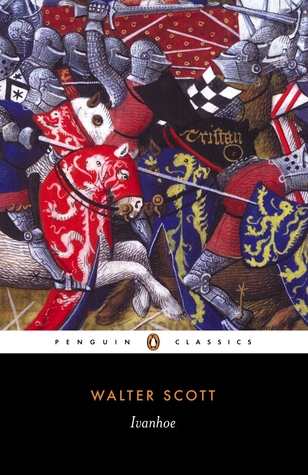
Author: Sir Walter Scott
Publication Year:1819
IVANHOE (1819) was the first of Scott's novels to adopt a purely English subject and was also his first attempt to combine history and romance, which later influenced Victorian medievalism. Set at the time of the Norman Conquest, Ivanhoe returns from the Crusades to claim his inheritance and the love of Rowena and becomes involved in the struggle between Richard Coeur de Lion and his Norman brother John. The gripping narrative is structured by a series of conflicts: Saxon versus Norman, Christian versus Jew, men versus women, played out against Scott's unflinching moral realism. --Summary from Goodreads
Ivanhoe, like many classics I’ve read, is a combination of
things I liked, things I didn’t like, and things I wish the author could have
done differently. Instead of trying to work my thoughts out coherently into
some kind of review, I decided just to make lists.
Good Things About
Ivanhoe
- It set in medieval times with knights and castles and ideas of chivalry. There are well known characters such as Prince John, Richard the Lionheart, Robin Hood and his merry men.
- It is obvious that Scott did his research. The world is full of rich details and is definitely worth a read if you ever plan on writing about this era.
- The story provides a good account of the class differences between the Normans and the Saxons as well as the persecution of Jewish people in England at the time. Also uses the history of the English language to illustrate the class differences between Saxon and Normans. The Normans brought over the idea of chivalry and knightly games, and yet Wilfred Ivanhoe, a Saxon, embodies the knightly ideal better than every Norman in the novel. It’s just great!
- The female characters, Rowena and Rebbeca, are awesome. Rowen is a Saxon lady who is somehow related to Alfred the Great, which made her Saxon royalty. She is the ward of Sir Cedric who has treated her like a princess her entire life and, as a result, she is used to being in a position of power. The only time Cedric opposed her was when she fell in love with his son, but that didn’t matter much because she had already made up her mind and there was no way he was going to change it. Rowena is a lady who knows what she wants and won’t back down. Rebecca is a Jewish lady whose family is being persecuted for their faith. She is intelligent and calm and wise. She is always willing to help someone in need and will take action to see that the right thing is accomplished. Both ladies take action when the head of their household is being unjust and see that everything is dealt with honorably.
- Urfried is old and mean and bitter, has a dark past, and a taste for revenge. She’s barely in it, but she is one of the most interesting characters in the book.
- Beautiful relationship between a fool and his master. Seriously, it brought a tear to my eye.
Issues I Had With
Ivanhoe
- I could literally name off 10+ characters that had more page time than Ivanhoe. He’s one of the only characters that the reader never gets a look inside his mind. He’s the perfect embodiment of chivalry, nothing more.
- It lacks focus because there are ton of characters that the story follows. I think its purpose was to focus on the time, not any specific character(s)… which I find annoying.
- While it was painting a sympathetic picture of the Jewish characters and addressed the persecution they faced, Isaac still managed to be built out of stereotypes. That being said, I think it made his character similar to Cedric in many ways. Both of them followed the letter, not the spirit, of the law of their culture while their children embody everything that they are supposed to be.
- It’s so LONG! And there’s so much dry description! And you keep waiting for Ivanhoe to do something, but he only has two moments of glory which are jousting scenes. (If you haven’t noticed, the lack of the “main character” really bothers me)
It’s an interesting books and I’m glad I read it, but if you’re
just looking for a random classic to read this probably shouldn’t be the one
you pick up. If you are interested in the time period or topics, are studying
19th century literature, or just have a ton of patience: go for it!
-Christina

